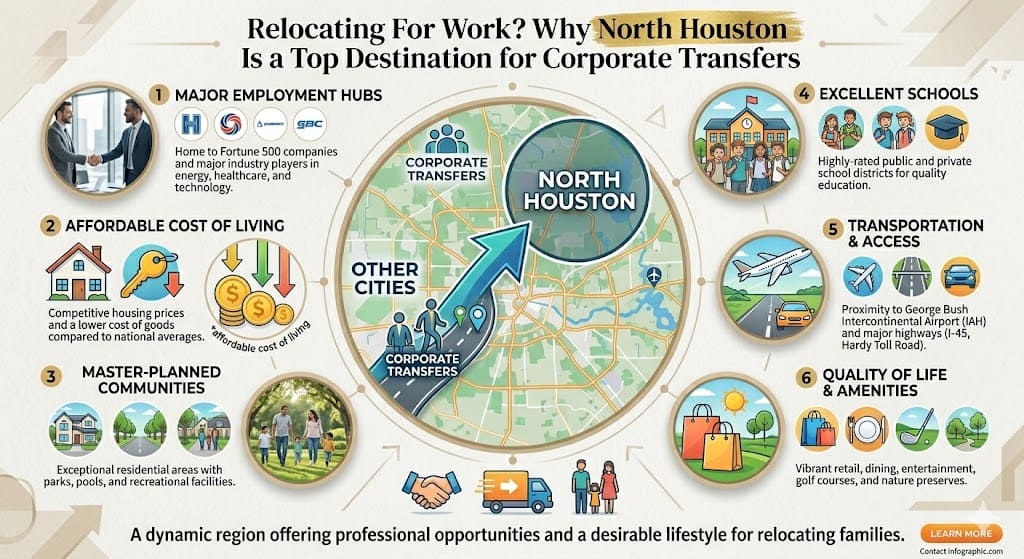
If you've just received news of a job transfer or corporate relocation to the Houston area, the first question most professionals ask isn't about the job — it's about where to live. North Houston has become one of the most sought-after landing zones for corporate transferees in the entire country, and it's not hard to understand why. The combination of a strong job market, exceptional housing value, no state income tax, and master-planned communities purpose-built for professionals makes this corridor stand out from virtually any comparable metro.
As a licensed relocation specialist serving Cypress, The Woodlands, Conroe, and Magnolia, I've guided dozens of corporate transferees through the process of buying a home remotely, navigating the North Houston market on a compressed timeline, and landing in a community that genuinely fits their lives. Here's everything you need to know.
Already have your relocation package? Ask your HR coordinator whether your package includes buyer's agent assistance and closing cost coverage before you start your home search. Many packages include benefits that go unused simply because employees don't know to ask.
Why North Houston Consistently Attracts Corporate Transferees
No State Income Tax — A Significant Financial Advantage
Texas has no state income tax. For a professional relocating from California, New York, Illinois, or Washington, this represents an immediate and meaningful increase in take-home pay — often equivalent to a salary increase of several percentage points. When combined with lower housing costs than most major metros, the financial case for relocating to North Houston is compelling in a way that's hard to replicate elsewhere.
A Concentration of Major Employers Along the Corridor
North Houston's employment landscape is anchored by some of the most significant corporate presences in the country. ExxonMobil's campus in The Woodlands employs thousands and draws transferees from across the globe. The Houston Methodist system, Memorial Hermann, and affiliates of the Texas Medical Center — the world's largest medical complex — operate facilities throughout North Houston. HP Inc., Aon, and a growing concentration of logistics, technology, and energy companies along the Grand Parkway corridor have made this one of the most economically diverse suburban employment zones in the South.
Exceptional Housing Value vs. Other Major Metros
A household relocating from the San Francisco Bay Area, Seattle, or New York will find that their housing dollar goes dramatically further in North Houston. The median home price in the Cypress–Conroe–Woodlands corridor hovers around $320K–$400K, with new construction readily available and master-planned communities offering resort-style amenities at prices that would be unimaginable in comparable coastal suburbs. For many transferees, a North Houston relocation represents the first realistic opportunity to buy a home with space, quality finishes, and a yard at a price that fits a professional salary.
Master-Planned Communities Designed for Professional Life
The master-planned communities of Cypress and The Woodlands weren't built as afterthoughts — they were designed from the ground up to attract and retain professionals and their households. Walkable trails, resort-style amenity centers, lakes, restaurants, and proximity to major employment corridors are all built into the community's DNA. For transferees arriving without an established local network, these communities provide an immediate social infrastructure — neighbors who are similarly situated, community events, and shared spaces that accelerate the feeling of belonging.
George Bush Intercontinental Airport — 20–35 Minutes Away
For professionals who travel frequently for work, proximity to a major international hub is non-negotiable. George Bush Intercontinental Airport (IAH) — one of the country's busiest — is typically 20–35 minutes from most North Houston communities depending on traffic and location. Direct international flights to Europe, Asia, Latin America, and across North America make IAH one of the most connected airports in the South. For transferees with family in other cities or regions, this access matters enormously in day-to-day quality of life.
One of the Fastest-Growing Corridors in the Country
North Houston's growth trajectory means that transferees arriving today are buying into a market with strong long-term fundamentals. The Grand Parkway (99) expansion continues to open new corridors and increase accessibility across the region. Population growth, corporate investment, and infrastructure development have consistently characterized this area for the past decade — and current projections suggest that trend is sustained. Buying in this market isn't just a housing decision; it's a real estate investment in one of the country's most dynamic suburban growth corridors.
Which North Houston Community Is Right for Your Commute?
One of the most practical early questions for corporate transferees is which community best aligns with where you'll be working. Here's a quick-reference guide:
| If Your Employer Is Near… | Consider Living In… | Why |
|---|---|---|
| The Woodlands / ExxonMobil campus | The Woodlands, Conroe, Magnolia | Direct access; 5–20 min commute depending on location |
| Energy Corridor (I-10 West) | Cypress TX (Hwy 290 corridor) | Beltway 8 or Hwy 290 to I-10; 25–40 min commute |
| Downtown Houston / Medical Center | Cypress (south), The Woodlands | Hwy 290 or I-45 corridor; 35–50 min commute |
| Grand Parkway (99) corridor | Cypress, Conroe, Magnolia | Direct Grand Pkwy access from most communities |
| Bush Intercontinental Airport (IAH) | Conroe, The Woodlands, North Cypress | Closest major residential areas to IAH |
Commute tip: Houston traffic can be significant during peak hours. Before committing to a community, do a test drive of your intended commute route at your actual start and end time — not on a Saturday afternoon. The difference can be meaningful depending on your route and the community you choose.
How the Corporate Relocation Home Buying Process Works
Most corporate transferees are working with a compressed timeline and can't afford to spend months learning the market from scratch. Here's how I structure the process to get you into the right home efficiently:
Connect with a lender and get pre-approved. Simultaneously, we have a detailed priorities consultation — commute, budget, community preferences, timeline, and whether you're targeting new construction or resale. This gives us a focused search from day one rather than casting wide and wasting your limited time.
I conduct live video tours via FaceTime or Zoom, walking you through homes and neighborhoods in real time. For new construction communities, I tour model homes and communicate directly with builder sales teams on your behalf. You see every home before deciding which ones warrant an in-person visit.
If your timeline permits a scouting trip, we schedule a focused one-day or two-day itinerary covering your top communities and specific homes. Having already done the virtual groundwork, your in-person time is spent on the genuine contenders — not broad exploration. Many transferees make their final decision during or shortly after this visit.
Once you've identified your home, I prepare and present the offer, negotiate on your behalf, and guide you through the Texas option period and inspection process. For out-of-state buyers, I coordinate local inspectors and handle all logistics so you don't need to be physically present for most of these steps.
Texas allows remote online notarization (RON), meaning your closing can be completed entirely via video call from your current location. Many corporate transferees close on their North Houston home before their first day at the new office. Keys are waiting when you arrive.
Making the Most of Your Relocation Package
Corporate relocation packages vary significantly in what they cover, but most include some combination of the following benefits that directly affect your home purchase:
- Buyer's agent reimbursement or direct payment — many packages cover your agent's commission, though in most Texas transactions the seller pays the buyer's agent regardless.
- Closing cost assistance — some packages include a lump sum or direct payment toward closing costs, which typically run 2–3% of the purchase price.
- Temporary housing allowance — if your timeline doesn't allow you to close before your start date, a temporary housing allowance buys you time to make a considered decision rather than a rushed one.
- Mortgage assistance or buydown — some packages include interest rate buydown assistance, particularly valuable in the current rate environment.
- Loss-on-sale protection — if you're selling a home in a market where you may take a loss, some relocation packages include provisions to offset this.
Review your full package documentation carefully and ask your HR or relocation coordinator specific questions before assuming what's covered. Unused benefits are common simply because transferees didn't know to ask.
Frequently Asked Questions About Corporate Relocation to North Houston
Why do companies relocate employees to North Houston TX?
How quickly can I buy a home in North Houston when relocating for work?
What North Houston community is best for corporate transferees?
Does my employer's relocation package cover a buyer's agent?
Can I buy a home in North Houston without visiting in person?
Relocating to North Houston for Work?
Christine O'Brien is a relocation specialist who has helped corporate transferees from across the country find their home in Cypress, The Woodlands, Conroe, and Magnolia — often entirely remotely. Let's get started.
Book Your Free Relocation ConsultationChristine O'Brien is committed to the principles of the Fair Housing Act. We do not discriminate on the basis of race, color, religion, sex, national origin, disability, familial status, or any other protected class. Equal Housing Opportunity.